
What is neck pain?
- Neck pain is a symptom with several possible causes. Muscles, joints, discs, and nerves can all contribute.
- It may feel like aching, tightness, stiffness, or difficulty turning your head.
- Pain may also extend toward the head, shoulders, or upper back. Pain traveling into an arm may suggest irritation of a nerve.
Understanding neck pain starts with your symptoms, medical history, and examination. Imaging can provide useful information, but it is only one part of the assessment.
Does an abnormal MRI explain my neck pain?
Not necessarily. MRI can show changes in the spine, but some of these changes also occur in people who have no symptoms.
In a study of 1,211 volunteers without symptoms, 87.6% had cervical disc bulging. Spinal cord compression and changes in the spinal cord’s MRI signal were much less common. These percentages describe that study population; they do not predict whether an individual will develop pain.
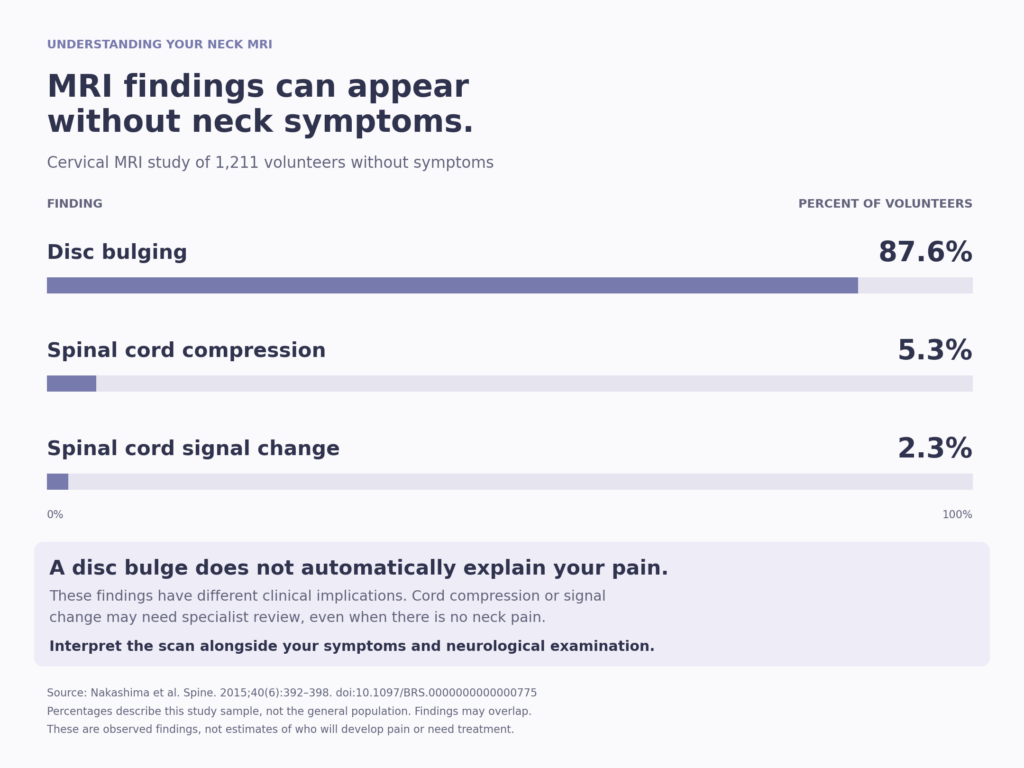
A disc bulge does not automatically require an injection or surgery. Your provider considers whether the finding matches the location of your symptoms and the results of your examination.
Some findings do require closer attention. Spinal cord compression or signal changes deserve clinical review, particularly when accompanied by weakness, hand clumsiness, or trouble walking.
When is imaging helpful?
Not everyone with neck pain needs an MRI immediately. Imaging may help when there are persistent symptoms suggesting a pinched nerve, concerning examination findings, or a suspected fracture, infection, or other structural problem.
The appropriate test depends on the question being asked. X-rays, CT scans, and MRI provide different information. Your provider can explain how a scan might change your treatment plan.
What are some common sources of neck pain?
Muscle and soft-tissue pain
Muscle strain and tension can cause aching, stiffness, and tenderness. Symptoms may follow an injury, repetitive activity, or spending a long time in one position.
Treatment often includes movement breaks, gentle exercise, and physical therapy to improve comfortable movement, strength, and endurance.
Cervical facet joint pain
- The facet joints are small joints at the back of the spine that help guide movement.
- Pain from these joints may be felt in the neck, shoulders, upper back, or head.
- Facet joints can become painful after injury or with degenerative changes. Arthritis on an MRI does not, by itself, prove that a joint is causing pain.
When facet pain is suspected, cervical medial branch blocks can help assess whether the nerves supplying these joints are carrying the pain signals.
For selected patients who obtain appropriate relief from diagnostic blocks, radiofrequency ablation, also called radiofrequency lesioning or RFL, may provide longer-lasting relief.
Cervical radiculopathy: pain from an irritated nerve
Cervical radiculopathy occurs when a nerve leaving the neck becomes irritated or compressed.
- Pain may travel into the shoulder, arm, or hand.
- Tingling, numbness, or weakness may also occur.
- A disc herniation or narrowing around a nerve can contribute.
Many people improve with nonsurgical care, including physical therapy and appropriately selected medication. A cervical epidural steroid injection may be considered for certain types of persistent nerve pain. It is not a treatment for every type of neck pain. Progressive weakness or significant compression may require surgical evaluation.
Injection decisions involve an individual discussion of benefits and risks, including rare serious neurological complications.
Complex or persistent neck pain
Persistent pain can involve more than an ongoing problem in one muscle, joint, or disc. The nervous system may become more sensitive, while disrupted sleep, stress, and reduced activity can make recovery harder.
The pain is real. Cognitive and behavioral pain therapies can help with coping, sleep, fear of movement, and returning to meaningful activities. These approaches can work alongside physical rehabilitation and treatment of any identifiable pain source.
What is cervical whiplash?
Cervical whiplash describes a neck injury caused by a sudden movement of the head, such as during a motor vehicle collision, fall, or sports injury.
- Symptoms commonly include neck pain, stiffness, headaches, and discomfort around the shoulders.
- Symptoms may begin immediately or develop over the following hours.
- Several tissues may be involved. Strain of the small facet joint capsules is one possible source of pain.
New arm numbness, tingling, weakness, or difficulty walking after an injury needs assessment rather than being assumed to be uncomplicated whiplash.
Why can imaging look normal after whiplash?
Whiplash pain can be real even when an X-ray or MRI looks normal.
Routine imaging does not reliably show every painful soft-tissue or joint-capsule injury. However, imaging can be important when the history or examination raises concern for a fracture, instability, or injury involving nerves or the spinal cord. Routine advanced imaging is not usually recommended for uncomplicated whiplash.
How is cervical whiplash treated?
After serious injury has been excluded, treatment generally focuses on gradually restoring comfortable movement and everyday activity.
- Stay gently active: Modify activities as needed and build back gradually.
- Use guided exercises: Gentle range-of-motion exercises and progressive strengthening may help.
- Consider physical therapy: A therapist can tailor exercises to your symptoms and stage of recovery.
- Support symptom relief: Heat, ice, or medication recommended by your clinician may help you participate in rehabilitation.
Prolonged rest and routine use of a neck collar are generally discouraged unless a clinician identifies a specific reason for them. Many people improve over weeks to months, while some need longer-term support.
What if whiplash pain persists?
Persistent symptoms deserve reassessment and an individualized plan.
When facet joint pain is suspected, diagnostic medial branch blocks—and, for selected patients, RFL—may be considered. These treatments are most useful when directed at an identified pain source and combined with rehabilitation.
Sleep difficulties, distress after an accident, and fear of movement may also need attention. Addressing these factors is part of treating pain, rather than a suggestion that the symptoms are imaginary.
Why is a combined approach often helpful?
Different treatments address different contributors to pain. Your plan may include:
- Physical therapy and home exercise to improve movement, strength, and confidence.
- Activity pacing and gradual progression to make daily tasks more manageable.
- Cognitive pain therapy to develop practical skills for managing persistent pain.
- Sleep and stress support to address factors that can amplify symptoms.
- Acupuncture, which may help some people with chronic neck pain, although results vary.
- Selected medications or procedures when the expected benefit fits the suspected pain source and your health needs.
The goal is to improve your ability to move, sleep, work, and participate in the activities that matter to you.
When should I seek urgent medical care?
Get prompt medical assessment for new or worsening arm or hand weakness, numbness, loss of coordination, or balance problems.
Seek emergency care for sudden or rapidly worsening weakness, inability to walk, new loss of bladder or bowel control, or severe neck pain after significant trauma. Fever with a severe headache and a stiff neck also needs emergency assessment.