
What is chronic low back pain?
- Chronic low back pain is pain that lasts longer than three months.
- Back pain describes a symptom – not one single disease or diagnosis. Different conditions can cause similar symptoms, and more than one factor may contribute.
- Pain may involve the spinal joints, discs, vertebral bones, muscles, or nerves. Sometimes there is no single structural explanation.
- When pain persists, changes in the nervous system can make it a health condition in its own right.
Understanding your pain involves more than identifying a finding on an MRI. We consider your symptoms, examination, medical history, daily activities, and goals for treatment.
Does an abnormal MRI mean something is wrong with my back?
- MRI scans frequently show disc and joint changes in people who have no back pain.
- These findings become more common with age.
- A finding may contribute to pain, but its presence alone does not establish the cause or mean that a procedure is needed.
A review of 33 studies involving 3,110 people without symptoms found the patterns shown below. The studies predominantly used MRI.
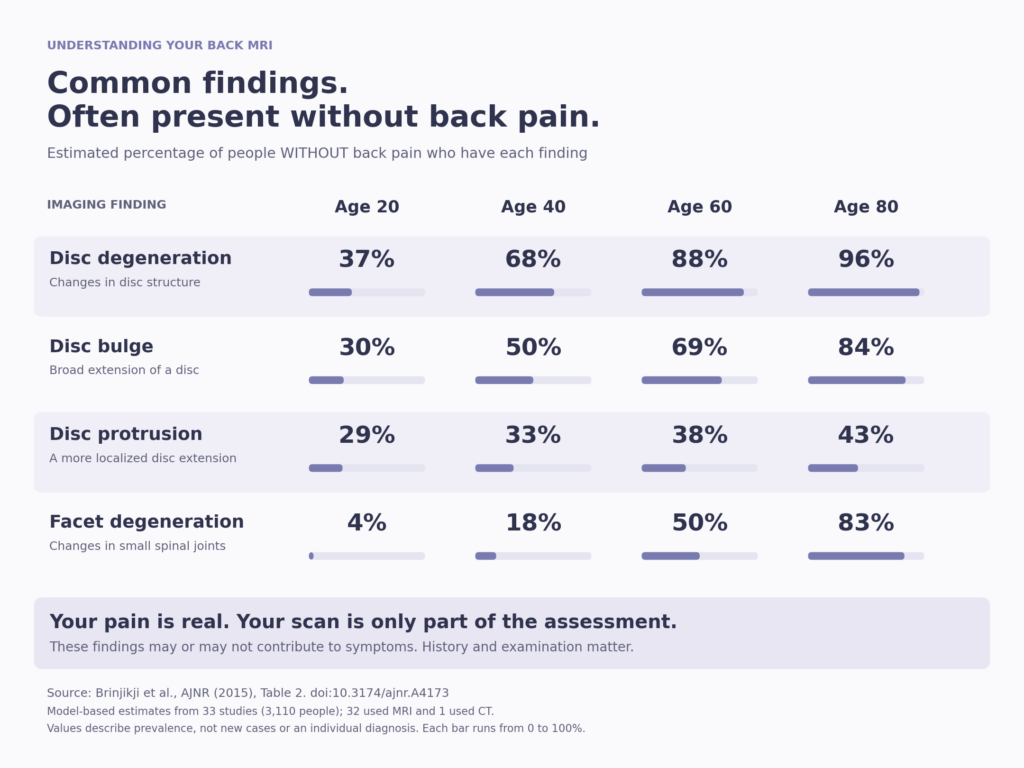
Your pain is real. Your scan is only one part of understanding it.
Why can back pain be complex?
- Pain can reflect a combination of tissue irritation, nerve injury, and increased sensitivity in the nervous system.
- Poor sleep, stress, muscle tension, and fear of movement can interact with pain.
- These influences do not mean that pain is imaginary or your fault.
- Treating only one contributor may leave other important contributors unaddressed.
Our goal is to understand the whole picture and help you move more comfortably, participate in daily life, and regain confidence in activity.
What is facet joint pain?
- Facet joints are small joints at the back of the spine that help guide movement.
- These joints can contribute to low back pain.
- Arthritis or degeneration on a scan does not, by itself, prove that a facet joint is painful.
How is facet joint pain treated?
- Physical therapy, exercise, and other conservative treatments are usually part of the plan.
- Medial branch blocks temporarily numb the small nerves that carry signals from the facet joints. Your response helps determine whether these joints are contributing to your pain.
- For selected patients who respond to diagnostic blocks, radiofrequency lesioning (RFL), also called radiofrequency ablation (RFA), may provide longer-lasting relief by using heat to interrupt those pain signals.
- Relief varies, and nerves can recover over time. Treatment does not reverse arthritis or address every possible source of back pain.
Possible procedure risks include soreness, bleeding, infection, nerve injury, and lack of meaningful relief.
What is vertebrogenic pain?
- Vertebrogenic pain arises from the vertebral endplates – the areas where the spinal bones meet the discs.
- Pain signals from these areas travel through the basivertebral nerve, which can be “ablated” or damaged with heat.
- Certain MRI findings, called Modic type 1 or type 2 changes, can support this diagnosis when they fit your symptoms and clinical evaluation.
- Modic changes alone do not establish the diagnosis or determine whether treatment is appropriate.
How is vertebrogenic pain treated?
- Treatment includes rehabilitation and other appropriate nonsurgical care.
- Intracept, a form of basivertebral nerve ablation, may be an option for carefully selected patients with persistent vertebrogenic pain.
- The procedure uses radiofrequency energy to target the basivertebral nerve within the affected vertebral bones.
- Research has studied selected patients with at least six months of pain, qualifying MRI changes, and an inadequate response to conservative treatment.
Intracept targets one potential source of pain. It does not treat every cause of back pain, so exercise and other therapies may still be needed.
What if back pain continues after spinal surgery?
- Some people continue to experience back or leg pain after surgery.
- Persistent pain deserves a fresh evaluation rather than an assumption that another operation is needed.
- Your team will review your symptoms, previous surgery, examination, and relevant imaging to look for treatable causes.
What treatments may help?
- A plan may include rehabilitation, appropriate medications, cognitive pain therapy, and selected procedures.
- Spinal cord stimulation (SCS) may be considered for selected patients with persistent nerve-related pain despite other treatments.
- SCS uses electrical impulses delivered through implanted leads to modify pain signaling. A temporary trial usually helps assess whether an implant may be worthwhile.
- It does not correct a structural problem and is not appropriate for everyone.
Evidence varies by the type of pain and stimulation system; some placebo-controlled research has not shown benefit. Your provider should discuss that uncertainty alongside potential benefits and risks, including infection, lead movement, and further surgery.
What is complex chronic back pain?
- Some people have several overlapping pain contributors, without one finding that fully explains their symptoms.
- The nervous system can become more sensitive, allowing pain to persist even after an initial injury has healed.
- Structural changes and nervous-system sensitivity can exist together.
How can cognitive pain therapy help?
- Cognitive pain therapy can help you understand pain and develop practical skills for managing it. In some cases, patients will actually experience less pain.
- Depending on the program, treatment may include pain education, cognitive behavioral strategies, relaxation, pacing, and a gradual return to meaningful activity.
- It can complement physical therapy and medical or procedural treatment.
This approach does not dismiss your pain. It addresses how the nervous system processes pain as part of comprehensive care.
Why do we recommend a multifaceted approach?
Different treatments address different parts of the pain experience. A personalized plan may include:
- Physical therapy and exercise: building strength, mobility, endurance, and confidence in movement.
- Acupuncture: an option that may help some people manage symptoms alongside active rehabilitation.
- Cognitive pain therapy: developing skills to manage pain, reduce distress, and support daily function.
- Daily self-management: pacing activity, improving sleep routines, and maintaining a sustainable home exercise program.
- Medications or targeted procedures: when the expected benefits, risks, and suspected pain source support their use.
Non-drug treatments are recommended as initial options for many people with chronic low back pain. A procedure may help create an opportunity to participate more comfortably in rehabilitation; it does not necessarily replace it.
Who should consider an evaluation?
- People whose back pain persists or repeatedly returns.
- People whose pain interferes with sleep, walking, work, or everyday activities.
- People who have not improved enough with their current treatment plan.
- People with ongoing pain after spinal surgery.
At Lowell Spine & Pain Associates, we work with you to identify likely contributors and build a plan around your needs and goals.
When should I seek urgent care?
Seek emergency care for back pain with new difficulty urinating, loss of bladder or bowel control, numbness around the groin or saddle area, or rapidly worsening leg weakness. These symptoms may indicate serious nerve compression.
Contact a clinician promptly for back pain accompanied by fever, unexplained weight loss, or a significant injury.